How to organize notes better, isn't really a 'method' problem
Why searching for how to organize notes better or digital minimalism always seems to end after a few days. Why methods like PARA and Zettelkasten don't stick, and a different way to think about cutting down on organizing itself.
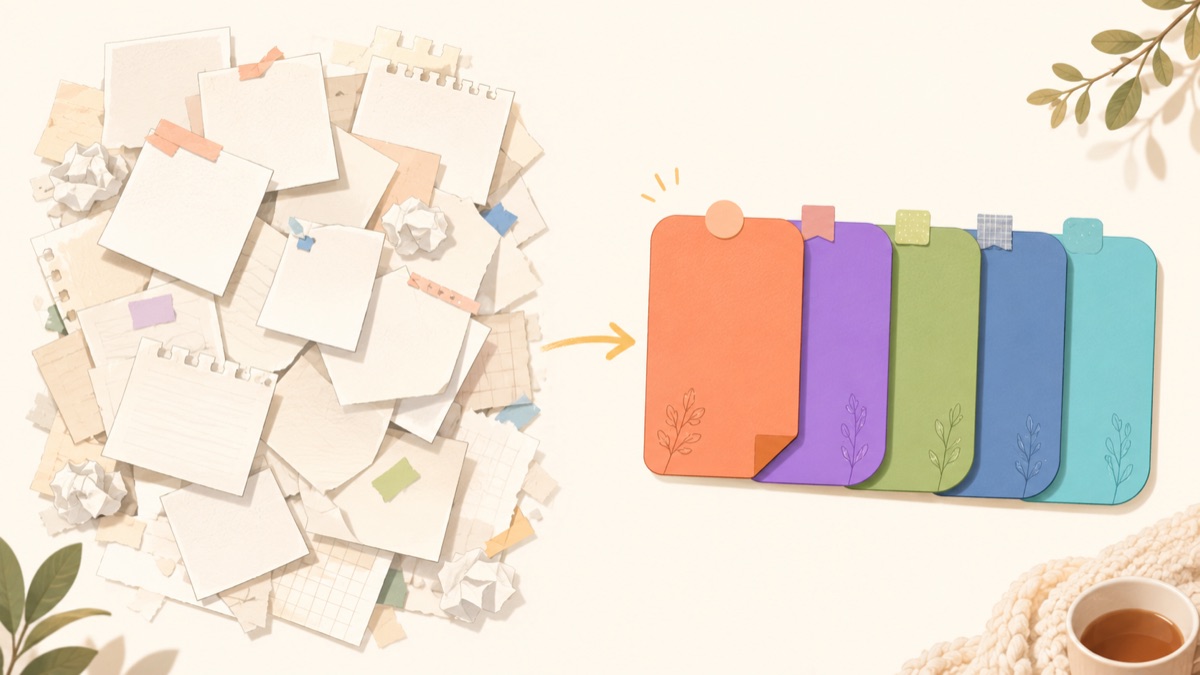
Search for "how to organize notes better" and you'll get mostly the same answers: split things into categories, add tags, set aside time once a week to clean up. Search for "digital minimalism" and it's not that different either — use fewer apps, clear out what you don't need.
The thing is, none of this advice is wrong. So why do we keep ending up back in the same place?
The methods that already exist
If you've ever looked into organizing notes, you've probably run into a few well-known approaches.
PARA sorts everything into four categories: Projects, Areas, Resources, and Archives. Zettelkasten is a method where you write short, individual notes and link them to each other to build a web of knowledge. On a lighter note, there's also the two-minute rule — deal with a note the moment you capture it, within two minutes.
All of these are proven methods. The problem isn't the method itself — it's that every one of them is a system that only keeps working as long as a person keeps maintaining it by hand.
Why it always fizzles out after a few days
The first few days go fine. A new note comes in, you decide which category it belongs to, add a tag, maybe link it to something else. But you have to make that same judgment call for every single note, over and over.
After a few busy days, notes you told yourself you'd "just save for now and organize later" start piling up. And that "later" usually never comes. Every time you open an unsorted note pile, it feels a little more overwhelming, until eventually you stop organizing — and often stop taking notes altogether.
This isn't a willpower problem. Sorting is a small decision you have to make over and over, every time you write something down. No matter how well-designed the method is, the assumption that a person will keep making that decision doesn't change.
Digital minimalism isn't about fewer apps — it's about fewer decisions
When people talk about digital minimalism, the conversation usually turns to cutting down the number of apps — one note app, one to-do app, and that's it.
But even after merging everything into one app, you often still have to decide where each note goes — which folder, which tag. Real minimalism, we think, has less to do with counting tools and more to do with how much you can reduce the "where does this go?" decision itself.
So we handed that decision over to AI
That's roughly the conclusion we came to while building Pilofy. Organizing notes isn't hard because people don't know how — it's hard because keeping any method going takes ongoing effort. So we decided to let AI take over the sorting itself.
Just save a photo or some text, and AI automatically organizes it into the shape that fits — a receipt, a travel plan, a business card. No folders to create, no tags to pick.
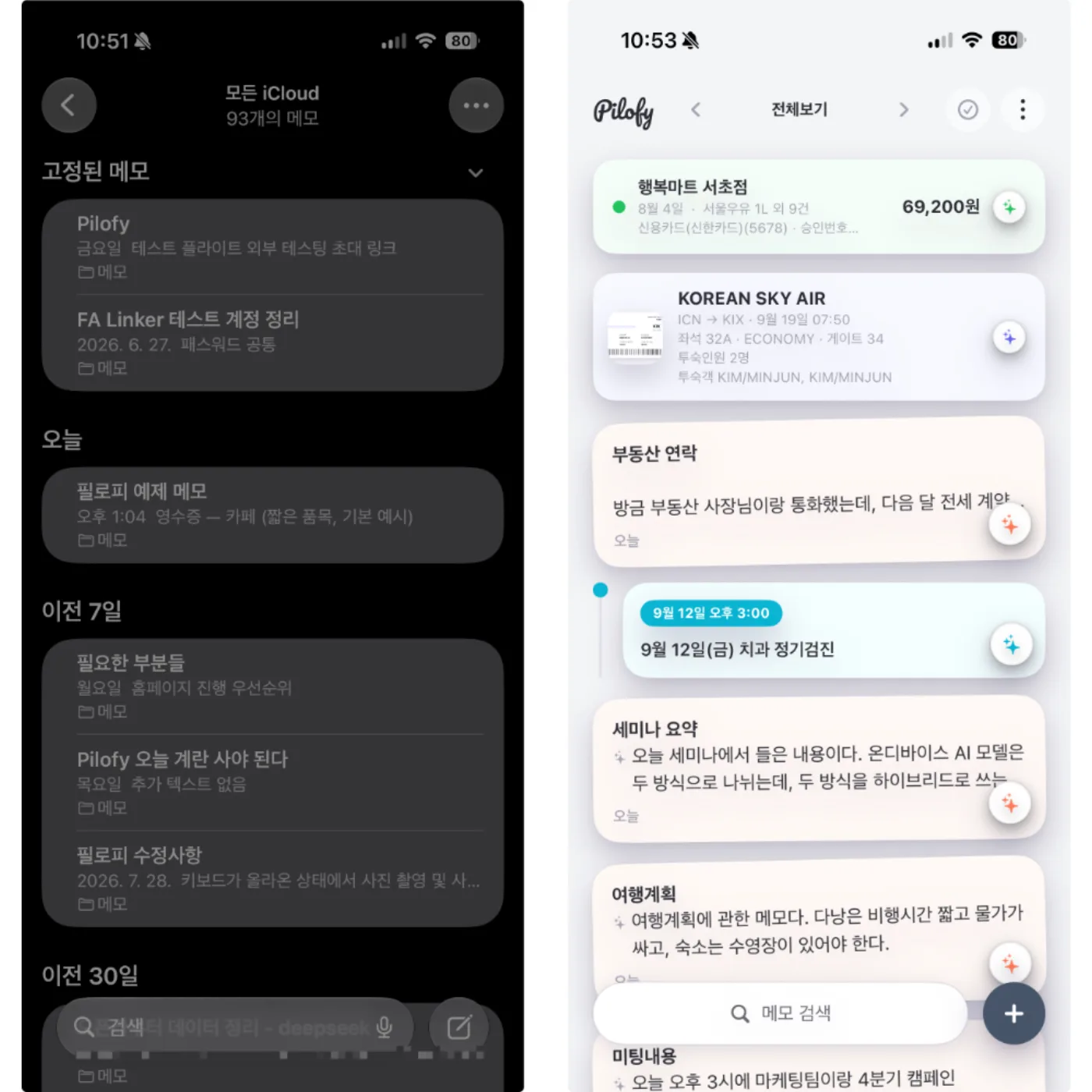
Finding things works the same way. Instead of opening a search box and typing a keyword, you scroll through color-coded cards until something catches your eye — though a keyword search is right there too, whenever you remember exactly what you're looking for.
It's not perfect, but that's not really the point
One thing we don't want to gloss over: AI sorting isn't always correct. If the handwriting is unclear or a note's content is ambiguous, it can misclassify something, or decide it doesn't fit any category at all. We're still measuring and refining that accuracy, and we'll keep improving it going forward — we can't honestly promise it'll ever be perfect.
But we think the real question isn't "is it perfect," it's "is it better than not sorting at all." A pile of notes with zero organization and a pile where most things are sorted correctly and a few are wrong are two very different situations. In the second case, most of the work is already done — you just fix what's wrong as you notice it. In the first, you're starting from scratch every time. The gap between a slightly imperfect sort and no sorting at all is bigger than it looks.
There's also an unexpected side effect to that review step. When AI suggests how something should be sorted, you naturally glance over it and think, "does this look right?" Advice like "set aside time once a week to organize" is genuinely hard to stick to on its own. But checking an AI-suggested sort happens automatically every time you save a note — so the habit of revisiting your notes builds itself, without you having to carve out extra time for it.
Instead of learning one more method
Learning another organizing method might not be the answer. PARA, Zettelkasten, the two-minute rule — they're all good tools. But if you don't have the bandwidth to keep maintaining one by hand, it's worth considering whether you can cut down on the maintenance itself instead.
Pilofy is coming soon with iOS 27 — built on on-device AI through Apple Intelligence, so organizing starts the moment you save a note.